Why this matters
Think of casino chips. Inside the casino they work perfectly: you can bet with them, cash them in at the cashier, and everyone takes them at face value. Step outside, and nobody accepts them with no questions asked.
Money is different. One hundred rand held at one bank is worth one hundred rand held at any other bank, anywhere in the country, even in a crisis. As money goes digital, the question is whether new forms of money will behave like real money or like casino chips.
That is the question behind Chapter III of the Bank for International Settlements (BIS) Annual Economic Report 2026, “Anchoring trust in money: innovation beyond stablecoins”. This briefing summarises the chapter in plain language.
Learning objectives
Estimated time: about 18 minutes (an 8-minute video and about 10 minutes of reading).
By the end of this lesson, you will be able to:
- Explain the properties that make money trusted: a common unit of account, singleness, elasticity and integrity.
- Describe what tokenisation could improve, and how public and private ledgers differ.
- Explain why the BIS says today’s stablecoins fall short as money, and what could happen if they grew large.
- Describe the BIS’s proposed way forward, including the unified ledger and Project Agorá.
1. What makes money trusted
The chapter says money works because people accept it as final payment “with no questions asked”. Two foundational properties make that possible:
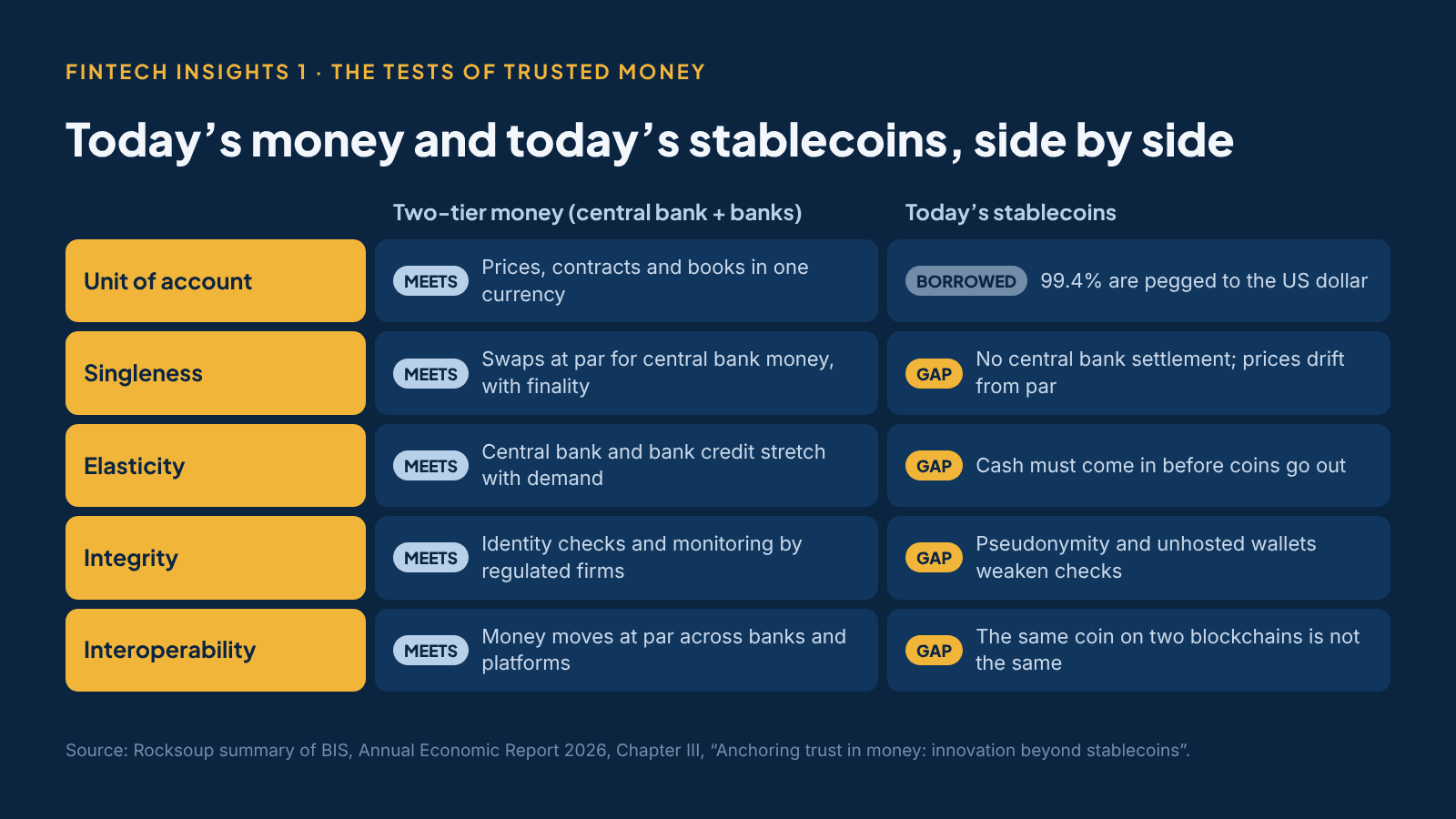
- A common unit of account. Everyone agrees to price goods, write contracts and keep books in the same unit, such as the rand.
- Singleness. Every claim in that unit can be swapped one for one (“at par”) for central bank money, with finality. You never have to check where a payment came from before you accept it.
Two further features hold these up. Elasticity means the supply of liquidity can stretch when payment needs spike, such as at month-end or in a crisis. Integrity means the system keeps out money laundering and terrorist financing. The BIS also stresses interoperability, which it calls money’s “connective tissue”, because it lets money move at par across banks and platforms.
2. Today’s two-tier system
Today, trust rests on a two-tier system. The central bank sits on the first tier. It anchors the unit of account, settles payments between banks in central bank money and supplies liquidity, including in stress. Commercial banks and other regulated firms sit on the second tier. They onboard customers, check identities, monitor transactions, extend credit and provide most of the money people use.
The chapter says this arrangement “socialises trust”: the system does the checking, so you don’t have to vet every payment yourself. It took centuries of trial and error to build, and the chapter reminds readers that money is an institutional achievement, not just a technology.
3. What tokenisation could fix
The current system still has frictions. Databases don’t talk to each other, payments pass through long chains of messages and reconciliations, and cross-border payments are slow and costly.
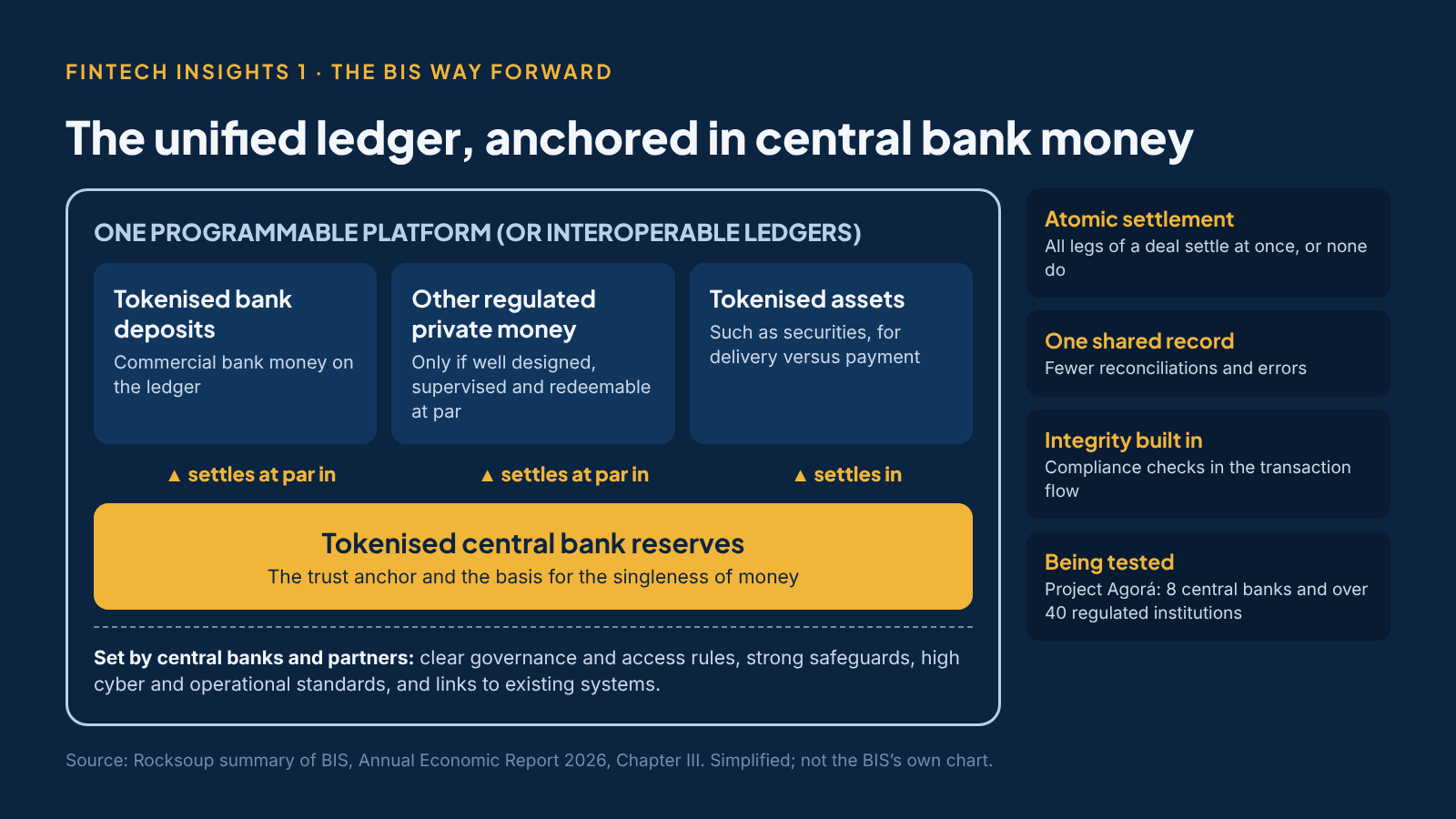
Tokenisation means recording money or assets as digital tokens on a programmable ledger. The BIS sees real potential benefits: a single shared record, fewer reconciliations, atomic settlement (all legs of a deal settle at once, or none do) and automated, round-the-clock processing through smart contracts. These benefits depend on having reliable money on the ledger.
The chapter splits ledgers into two types:
- Public permissionless blockchains are open to anyone. They are transparent and competitive, but suffer congestion, fragmentation and weak integrity controls.
- Private permissioned networks admit only approved, identifiable firms. They suit regulated finance better, but risk becoming walled gardens that limit competition.
- Working: on a permissioned platform that settles in central bank reserves, compliance checks and settlement happen in one coordinated step.
- Warning sign: assets sit on separate networks that can’t talk to each other, so they have to be moved through ad hoc “bridges” that add operational risk.
4. Stablecoins: big headlines, modest use
Stablecoins are privately issued tokens on public blockchains that aim to keep a stable value against a reference asset, usually the US dollar. Unlike bank deposits, they are issued without the central bank and banking framework behind them. The chapter’s key figures:
- The stablecoin market was worth around US$320 billion at the end of May 2026, which is small next to the trillions of dollars in bank deposits.
- 99.4% of fiat-backed stablecoins (by market value) are pegged to the US dollar.
- Stablecoin transactions totalled about US$28 trillion in 2025. That is less than three business weeks of settlements in the largest US wholesale payment systems.
So far, stablecoins are used mainly for crypto trading and, to a lesser extent, as an offshore store of value in emerging economies with weak currencies. As a cross-border payment tool, their performance is uneven once fees, spreads and the costs of getting in and out are counted.
5. Where stablecoins fall short
Measured against the tests in section 1, the BIS finds four gaps:
- Integrity. Stablecoins account for a significant share of illicit activity on blockchains. Pseudonymous users and “unhosted” wallets, which no regulated firm controls, weaken identity checks.
- Singleness. Stablecoins don’t settle on central bank balance sheets. Their market prices drift from par and redemption has frictions, so the chapter compares them to exchange-traded funds (ETFs) rather than money.
- Elasticity. Issuers need cash in before coins go out, so supply can’t stretch when payment demand jumps.
- Fragmentation. A coin on Ethereum is not the same as a coin of the same name on Solana. The two ledgers don’t natively communicate.
Design and regulation decide where a stablecoin sits on a spectrum. At one end are money-like designs, always redeemable at par and backed by very safe reserves. At the other are investment-like designs that may drift from par and limit redemptions. Rules in the EU, Hong Kong, Japan, Singapore, the UK and the US share three pillars: redemption at par, fully backed reserves and limits on paying interest to holders.
- Working: a coin that can be redeemed at par promptly, with reserves in very safe, liquid assets and clear disclosure.
- Warning sign: a coin trades below face value in the market, or redemption comes with fees, delays or gates.
6. If stablecoins grew big
The BIS looks at what could happen if stablecoins were widely adopted despite these gaps. When people move bank deposits into stablecoins, banks lose stable retail deposits. Depending on what issuers hold as reserves, banks either get the money back as less stable wholesale deposits or lose central bank reserves. Funding costs can rise and lending can tighten, which could hurt small businesses that rely on smaller banks.
In the BIS model, calibrated to US data, even a stablecoin market of US$1 trillion to US$3 trillion has only a modest overall effect on economic activity. But large redemptions could force quick sales of reserve assets, such as treasury bills, and unsettle money markets. Competition from stablecoins could also bring benefits, such as lower payment fees and better deposit rates.
7. The way forward
The BIS calls for action on two fronts:
- Fix today’s stablecoins: capital and liquidity requirements, protections for coin holders, clear disclosure and resolution plans, and close international cooperation.
- Bring tokenisation into the two-tier system: central banks offer tokenised central bank reserves as the anchor for tokenised bank deposits and other well-regulated private money.
Its organising idea is a unified ledger: one programmable platform, or a system of interoperable ledgers, that brings tokenised central bank reserves, tokenised bank deposits, other regulated money and tokenised assets together. Project Agorá is testing this for cross-border payments, with eight central banks and over 40 regulated institutions. Meanwhile, the chapter says conventional systems should keep improving too, for example through longer operating hours and linked fast payment systems.
How the parts work together
The four tests explain why money is trusted, and the two-tier system is how they are delivered today. Tokenisation offers faster, programmable rails, but stablecoins show what happens when those rails run without the tests. The BIS answer is to keep the tests and upgrade the rails: innovation built on central bank money, not around it.
What it means for emerging markets
The chapter gives particular attention to emerging market and developing economies. It warns of “stablecoin dollarisation”: people holding US dollar stablecoins instead of their own currency, much as they have held dollar deposits in times of high inflation. Stablecoins can slip past foreign currency controls, and capital flows could become larger and more volatile. Past experience suggests that dollarisation, once established, tends to persist. If stablecoins came to be used for everyday payments, the local currency’s role, and the reach of local monetary policy, would weaken.
The chapter also notes a possible upside. The pressure can push countries to keep inflation low, manage public finances prudently and build efficient local payment systems.
Download: digital money trust check
Use the digital money trust check attached to this lesson. It turns the chapter’s tests into five questions you can ask about any stablecoin, token or digital payment product, with space to record your answers and a simple rating.
Self-check: could you explain it?
Answer yes or no:
- Could you explain “singleness of money” to a colleague in one sentence?
- Could you name the two tiers of today’s monetary system and what each does?
- Could you explain how a public permissionless ledger differs from a private permissioned one?
- Could you give two reasons why the BIS says today’s stablecoins fall short as money?
- Could you explain how large-scale stablecoin use might affect a bank’s funding?
- Could you describe the unified ledger and what it would hold?
Key takeaways
- Money is trusted because of a common unit of account and singleness, supported by elasticity, integrity and interoperability.
- Tokenisation could make payments faster and cheaper, but only with reliable money on the ledger.
- Today’s stablecoins fall short on integrity, singleness, elasticity and interoperability, and are used mainly for crypto trading.
- Wide stablecoin use could strain bank funding and, in emerging markets, drive “stablecoin dollarisation”.
- The BIS way forward is to fix stablecoin risks and bring tokenisation into the two-tier system, anchored in central bank money.
Think about it
- Which digital payment products do your customers or colleagues already use, and how would each score against the four tests of trusted money?
- If a customer asked whether a dollar stablecoin is “as good as money in the bank”, how would you answer, using the chapter?
- Which part of your own organisation’s work, such as payments, treasury or compliance, could change most if tokenised deposits became common?
Scoring guidance
Self-check. Give yourself 1 point for each “yes” you could explain out loud without notes. 5 or 6 points: you have a solid grasp of the chapter. 3 or 4: re-read the sections you missed. 0 to 2: watch the video again, then try the quiz.
Think about it: what a good answer includes
- A good answer names specific products and scores each on the unit of account, singleness, elasticity and integrity. Strong answers notice which products settle in central bank money and which don’t.
- Explain that bank deposits are redeemable at par within the two-tier system, while stablecoins can drift from par and may have redemption frictions. Strong answers mention the integrity and fragmentation gaps too.
- Name the function and the change, such as fewer reconciliations, atomic settlement or round-the-clock processing. The best answers also name a new risk, such as operational resilience or interoperability between platforms.
References
This briefing summarises Chapter III of the BIS Annual Economic Report 2026 in our own words and quotes only a few short phrases. All figures come from the chapter. Read the full chapter for the detail, the boxes and the charts. It is general guidance, not financial, investment or legal advice.
Read the transcript (Lerato and Peter, 8 minutes)
Opening
Lerato: Welcome to Fintech Insights from Rocksoup, where we take one important fintech report and unpack it in about ten minutes. I’m Lerato.
Peter: And I’m Peter.
Lerato: Today’s report comes from the Bank for International Settlements, the BIS.
Peter: That’s right. In June 2026 the BIS published its Annual Economic Report. Chapter three of the 2026 edition is called “Anchoring trust in money: innovation beyond stablecoins”. It asks a simple question. As money goes digital, how do we keep trusting it?
Casino chips
Lerato: Before we start, give me a picture. Why should I worry about trust? Money is money.
Peter: Think of casino chips. Inside the casino, a chip works perfectly. You can bet with it, you can cash it in at the cashier, and everyone accepts it at face value.
Lerato: But I can’t buy groceries with it.
Peter: Exactly. Outside the casino, nobody takes it with no questions asked. Real money is different. A hundred rand from one bank is worth a hundred rand from any other bank, everywhere, even in a crisis. The BIS says that is the heart of the matter.
What makes money trusted
Lerato: So what makes money trusted?
Peter: The chapter names two foundational properties. The first is a common unit of account. We all agree to price things, write contracts and keep books in the same unit.
Lerato: And the second?
Peter: The singleness of money. Every claim in that unit can be swapped at par, one for one, for central bank money, with finality. So you never have to check the pedigree of the money someone pays you.
Lerato: Is that enough?
Peter: Two more things hold it up. Elasticity means liquidity can expand when payments spike, like at month-end or in stress. And integrity means the system keeps out money laundering and terrorist financing. The BIS also stresses interoperability. It calls it money’s connective tissue, because it lets money flow across banks and platforms.
Lerato: Who delivers all of that today?
Peter: The two-tier system. The central bank sits at the top. It anchors the unit of account, settles payments in its own money and lends liquidity when needed. Commercial banks sit on the second tier. They onboard customers, check identities, extend credit and create most of the money we use. The chapter says this setup “socialises trust”, so you don’t need to vet every payment yourself.
What tokenisation could fix
Lerato: If the system works, why change it?
Peter: Because it still has frictions. Databases don’t talk to each other. Payments pass through long chains of messages and reconciliations. Cross-border payments are slow and costly, with different time zones and rules.
Lerato: And tokenisation helps how?
Peter: Tokenisation puts claims like money or assets onto a programmable ledger. That allows a single shared record, fewer reconciliations, atomic settlement, where all legs of a deal settle at once or not at all, and round-the-clock operation through smart contracts.
Lerato: Are all ledgers the same?
Peter: No. The chapter splits them into two types. Public permissionless blockchains are open to anyone. They are transparent and competitive, but they suffer congestion, fragmentation and weak integrity controls. Private permissioned networks only admit approved firms. They fit regulated finance better, but they risk becoming walled gardens.
Stablecoins in numbers
Lerato: Which brings us to stablecoins.
Peter: Stablecoins are tokens on public blockchains that try to keep a stable value against something like the US dollar. They are issued by private firms, without the central bank and bank framework behind them.
Lerato: How big are they?
Peter: Around 320 billion US dollars at the end of May 2026. That sounds a lot, but it is dwarfed by the trillions held in bank deposits. And 99.4% of fiat-backed stablecoins are pegged to the US dollar.
Lerato: What about how much they’re used?
Peter: About 28 trillion dollars of transactions in 2025. But the BIS says that is less than three business weeks of settlements in the largest US wholesale payment systems.
Lerato: So what are people actually using them for?
Peter: Mainly crypto trading. To a lesser extent, people in emerging economies with weak currencies hold them as an offshore store of value. They promise cheaper cross-border payments, but once you add fees, spreads and the cost of getting in and out, the results are uneven.
Where stablecoins fall short
Lerato: Where do they fall short?
Peter: The BIS lists four big gaps. First, integrity. Stablecoins make up a significant share of illicit activity on blockchains, because users can stay pseudonymous and use unhosted wallets.
Lerato: Second?
Peter: Singleness. Stablecoins don’t settle on central bank balance sheets. Their market prices drift from par, and redeeming them can be difficult. The chapter says they behave more like exchange-traded funds than money.
Lerato: Third?
Peter: Elasticity. Issuers must receive cash before they create coins, so supply can’t stretch when demand jumps. And fourth, fragmentation. A coin on Ethereum is not the same as a coin with the same name on Solana. They sit on separate ledgers that don’t talk to each other.
Lerato: Could better rules fix this?
Peter: Partly. The BIS places stablecoins on a spectrum. At one end are money-like designs, always redeemable at par and backed by very safe assets. At the other end are investment-like designs that can drift from par. The more like an investment, the less useful as money. Regulators in the EU, the US, the UK, Singapore, Japan and Hong Kong share three common pillars: redemption at par, full reserves and limits on paying interest.
If stablecoins grow big
Lerato: Suppose they grow anyway. What happens?
Peter: When people swap bank deposits for stablecoins, banks lose stable retail deposits. Depending on what issuers hold as reserves, banks get that money back as less stable wholesale deposits, or they lose central bank reserves. Either way, funding costs can rise and lending can tighten. Small businesses that rely on smaller banks could feel it most.
Lerato: Is that a big deal?
Peter: In the BIS model, calibrated to US data, even a stablecoin market of one to three trillion dollars has only a modest effect on economic activity. But large redemptions could still unsettle money markets, because issuers would sell their reserve assets in a hurry.
Emerging markets
Lerato: What does this mean for emerging economies like ours?
Peter: The chapter warns about “stablecoin dollarisation”. People may hold dollar stablecoins instead of their own currency, much as they hold dollar deposits in times of high inflation. Stablecoins can slip past controls on foreign currency. And past experience suggests dollarisation, once it takes hold, tends to persist.
Lerato: Any upside?
Peter: The BIS says that pressure can push countries to keep inflation low, keep public finances sound and build efficient local payment systems.
The way forward
Lerato: So what does the BIS recommend?
Peter: Action on two fronts. One, fix the weaknesses in today’s stablecoins, with capital and liquidity rules, protections for holders and international cooperation. Two, bring tokenisation into the two-tier system.
Lerato: What would that look like?
Peter: The BIS proposes a unified ledger. It would hold tokenised central bank reserves, tokenised bank deposits and other well-regulated money and assets on one programmable platform, anchored in central bank money. Project Agorá is testing the idea, with eight central banks and over 40 regulated firms working on cross-border payments.
Close
Lerato: Peter, one line to remember?
Peter: New technology can make money faster and smarter. But money only works if it stays redeemable at par, flexible, clean and connected. Innovation should build on that trust, not around it.
Lerato: The lesson, a digital money trust check and a quiz are on rocksoup.co.za. The full chapter is on the BIS website. Thanks for listening.
Peter: See you next time.